
They say trading is an art, but I’ve always seen it as a science. When I first started my journey in the forex market, I was overwhelmed by the sheer volume of information, the conflicting opinions, and the gut-wrenching volatility. It felt like navigating a stormy sea without a compass. That all changed when I discovered forex technical analysis. It wasn’t a magic crystal ball, but it was the closest thing to a scientific method for understanding market movements. It gave me a framework, a set of tools, and a language to interpret the seemingly chaotic dance of currency pairs. This guide is the culmination of years of my own experience, testing, and refining strategies. It’s the masterclass I wish I had when I was starting out, designed to take you from a complete beginner to a confident technical analyst in 2026.
So, what exactly is this powerful tool? At its core, forex technical analysis is the study of historical price action to identify patterns and forecast the future direction of prices. Think of yourself as a market detective. You’re not concerned with *why
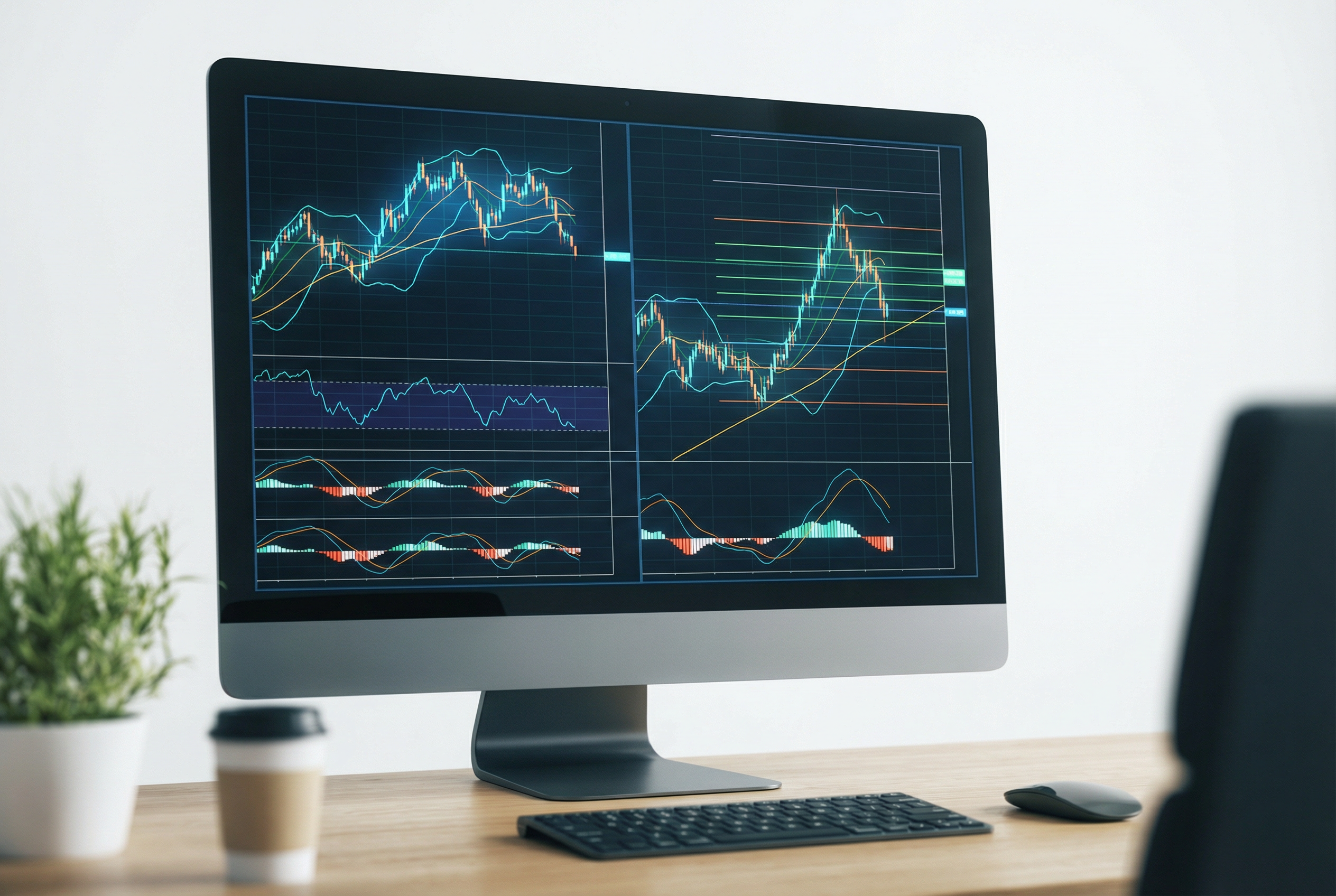
Honestly, trying to trade forex without technical analysis is like trying to drive with your eyes closed. You might get lucky once or twice, but a crash is inevitable. The forex market is the largest and most liquid financial market in the world, with trillions of dollars traded every day. This high volume of trading creates clear and identifiable patterns that can be exploited for profit. Technical analysis provides a structured approach to trading, helping you to make objective decisions based on data rather than emotion. It allows you to identify high-probability trading opportunities, manage your risk effectively, and develop a consistent trading strategy. In the fast-paced world of forex, where prices can change in the blink of an eye, having a solid understanding of technical analysis is not just an advantage; it’s a necessity.
Table of Contents
- What is Forex Technical Analysis?
- Why is Technical Analysis Important in Forex Trading?
- Core Concepts of Forex Technical Analysis
- Chart Types
- Timeframes
- Forex Chart Patterns
- Reversal Patterns
- Continuation Patterns
- Bilateral Patterns
- Top Forex Indicators for Technical Analysis
- Moving Averages (MA)
- Relative Strength Index (RSI)
- Moving Average Convergence Divergence (MACD)
- Bollinger Bands
- Fibonacci Retracement
- Building a Forex Trading Strategy with Technical Analysis
- Step 1: Define Your Trading Style
- Step 2: Choose Your Indicators and Patterns
- Step 3: Set Your Entry and Exit Rules
- Step 4: Implement Risk Management
- Step 5: Backtest and Refine Your Strategy
- Comparison of Technical Analysis Tools
- Comparison of Trading Strategies

Frequently Asked Questions (FAQ)
- References
Core Concepts of Forex Technical Analysis
Alright, let’s get into the nitty-gritty. To become a successful technical analyst, you need to master a few core concepts. These are the building blocks of your entire trading strategy. Don’t worry, I’ll break them down in a way that’s easy to digest. I remember when I first saw a forex chart; it looked like a bunch of random squiggles. But once you understand the language of the charts, it’s like having a superpower.
There are three main types of charts you’ll encounter in your trading journey: line charts, bar charts, and candlestick charts. Each one tells the same story, but in a slightly different way.
In forex trading, a timeframe refers to the period of time that each bar or candlestick on your chart represents. You can choose from a wide range of timeframes, from one minute to one month. The timeframe you choose will depend on your trading style and how long you plan to hold your trades.
Here’s the thing: there’s no single
Forex Chart Patterns
Now for the really fun part: chart patterns. These are the formations that you’ll see on your charts that can give you clues about where the price is headed next. I’ve spent countless hours staring at charts, and I can tell you that these patterns are not just random noise. They’re a reflection of the collective psychology of the market. Learning to spot these patterns is like learning to read the market’s mind. see also: Best Forex Brokers in 2026: The Definitive Comparison of Fee.
Reversal patterns are formations that signal a potential change in the direction of the trend. When you see one of these patterns, it’s like a warning sign that the current trend is running out of steam and a new trend is about to begin.
Continuation patterns are formations that signal a temporary pause in the trend, after which the trend is likely to continue in its original direction. These patterns can be great opportunities to enter a trade in the direction of the prevailing trend.
Bilateral patterns are formations that can result in a breakout in either direction. These patterns are a bit trickier to trade than reversal or continuation patterns, but they can also be very profitable if you know what you’re doing.
Top Forex Indicators for Technical Analysis
If chart patterns are the language of the market, then indicators are the grammar. They help you to make sense of the price action and to identify high-probability trading opportunities. There are literally hundreds of indicators out there, but you don’t need to know all of them. In fact, I’ve found that it’s better to master a few key indicators than to be a jack of all trades and a master of none. Here are the indicators that I use every single day in my own trading.
Moving averages are the bread and butter of technical analysis. They smooth out the price action and help you to identify the direction of the trend. A moving average is simply the average price of a currency pair over a specific period of time. For example, a 20-period moving average is the average price over the last 20 periods. There are two main types of moving averages: simple moving averages (SMA) and exponential moving averages (EMA). The only difference between them is that the EMA gives more weight to recent prices, which makes it more responsive to changes in the trend.
The RSI is a momentum oscillator that measures the speed and change of price movements. It oscillates between 0 and 100 and is used to identify overbought and oversold conditions in the market. A reading above 70 is considered to be overbought, which means that the price may be due for a correction. A reading below 30 is considered to be oversold, which means that the price may be due for a bounce. The RSI is a great tool for identifying potential turning points in the market.
The MACD is a trend-following momentum indicator that shows the relationship between two moving averages of a currency pair’s price. The MACD is calculated by subtracting the 26-period EMA from the 12-period EMA. A nine-day EMA of the MACD, called the “signal line,” is then plotted on top of the MACD line, which can function as a trigger for buy and sell signals. I love the MACD because it’s a versatile indicator that can be used to identify the direction of the trend, the momentum of the trend, and potential turning points in the market.
Bollinger Bands are a volatility indicator that consists of a middle band (which is a simple moving average) and two outer bands that are plotted two standard deviations away from the middle band. The bands widen when volatility is high and narrow when volatility is low. Bollinger Bands are a great tool for identifying potential breakouts and for gauging the strength of the trend.
The Fibonacci retracement tool is based on the key numbers identified by the mathematician Leonardo Fibonacci in the 13th century. In technical analysis, Fibonacci retracement is created by taking two extreme points (usually a major peak and trough) on a chart and dividing the vertical distance by the key Fibonacci ratios of 23.6%, 38.2%, 50%, 61.8%, and 100%. Once these levels are identified, they can be used as potential support and resistance levels. I’ve found that the 61.8% level is particularly powerful. It’s often referred to as the “golden ratio” and it’s a level where the price often finds support or resistance.
Building a Forex Trading Strategy with Technical Analysis
Alright, now that you have a solid understanding of the core concepts of technical analysis, it’s time to put it all together and build your own trading strategy. This is where the rubber meets the road. A trading strategy is a set of rules that you will follow to identify trading opportunities, enter and exit trades, and manage your risk. It’s your personal roadmap to success in the forex market. I’ve seen too many traders fail because they didn’t have a plan. They were just winging it, and that’s a recipe for disaster. Don’t be one of them. Take the time to build a solid trading strategy, and you’ll be miles ahead of the competition.
The first step in building a trading strategy is to define your trading style. Are you a scalper, a day trader, a swing trader, or a position trader? Your trading style will determine the timeframes you use, the indicators you focus on, and the amount of time you spend in front of your charts. There’s no right or wrong answer here. It all depends on your personality, your risk tolerance, and your lifestyle. I’ve tried all of them, and I’ve found that swing trading works best for me. I like the idea of catching the bigger market moves without having to be glued to my screen all day.
Once you’ve defined your trading style, it’s time to choose your weapons. I’m talking about the indicators and chart patterns that you will use to identify trading opportunities. As I mentioned earlier, it’s better to master a few key indicators than to be a jack of all trades and a master of none. Choose a combination of indicators that complement each other and that you feel comfortable with. For example, you might use a moving average to identify the trend, the RSI to identify overbought and oversold conditions, and the MACD to confirm the momentum of the trend.
This is one of the most important steps in building a trading strategy. You need to have a clear set of rules for when you will enter and exit a trade. Your entry rules should be based on a specific combination of signals from your indicators and chart patterns. For example, you might decide to enter a long trade when the price is above the 200-period moving average, the RSI is below 30, and the MACD is crossing above the signal line. Your exit rules should be just as clear. You need to know when you will take profits and when you will cut your losses. I can’t stress this enough: you must have a plan for every trade.
Risk management is the key to long-term success in the forex market. You can have the best trading strategy in the world, but if you don’t manage your risk properly, you will eventually blow up your account. I’ve seen it happen time and time again. The most important rule of risk management is to never risk more than you can afford to lose on a single trade. A good rule of thumb is to risk no more than 1-2% of your account on any given trade. You also need to use a stop-loss order on every trade to limit your potential losses. read our guide on how to set risk-to-reward ratios that wo.
Once you’ve built your trading strategy, it’s time to put it to the test. The best way to do this is to backtest it on historical data. This will allow you to see how your strategy would have performed in the past and to identify any potential flaws. You can also use a demo account to test your strategy in a live market environment without risking any real money. Once you’re confident in your strategy, you can start trading with real money. But don’t forget to constantly monitor your performance and to refine your strategy as you go. The market is always changing, and your strategy needs to be able to adapt to those changes. How to Master Forex Risk Management Techniques in 2026 for Consistent Profits.
Comparison of Technical Analysis Tools
I know, I know… with so many tools at your disposal, it can be tough to decide which ones to use. To help you out, I’ve put together a comparison table of the most popular technical analysis tools. This should give you a better idea of the strengths and weaknesses of each tool and help you to choose the right ones for your trading style.
| Tool | Type | Best For | Pros | Cons |
|---|---|---|---|---|
| Moving Averages | Trend | Identifying the direction of the trend | Simple to use, effective in trending markets | Lagging indicator, can give false signals in ranging markets |
| RSI | Momentum | Identifying overbought and oversold conditions | Can be used to identify potential turning points, can be used to spot divergences | Can give false signals in strong trends |
| MACD | Trend/Momentum | Identifying the direction and momentum of the trend | Versatile indicator, can be used in a variety of ways | Can be complex to interpret, can lag behind the price |
| Bollinger Bands | Volatility | Identifying potential breakouts and gauging the strength of the trend | Dynamic support and resistance levels, can be used to identify overbought and oversold conditions | Can give false signals in ranging markets |
| Fibonacci Retracement | Support/Resistance | Identifying potential support and resistance levels | Based on a mathematical formula, can be very accurate | Subjective, can be difficult to draw correctly |
Comparison of Trading Strategies
Just as there are many different technical analysis tools, there are also many different trading strategies. The best strategy for you will depend on your trading style, your risk tolerance, and your personality. To help you choose the right strategy, I’ve put together a comparison table of the most popular trading strategies.
| Strategy | Timeframe | Holding Time | Pros | Cons |
|---|---|---|---|---|
| Scalping | 1-minute to 5-minute | Seconds to minutes | Many trading opportunities, can be very profitable | High stress, requires a lot of screen time, high transaction costs |
| Day Trading | 5-minute to 1-hour | Minutes to hours | No overnight risk, many trading opportunities | Requires a lot of screen time, can be stressful |
| Swing Trading | 4-hour to daily | Days to weeks | Less screen time, can catch bigger market moves | Overnight risk, fewer trading opportunities |
| Position Trading | Daily to weekly | Weeks to months | Very little screen time, can catch long-term trends | Requires a lot of patience, large stop-losses |
Frequently Asked Questions (FAQ)
I get a lot of questions about forex technical analysis, so I thought I would answer some of the most common ones here. If you have a question that isn’t answered here, feel free to reach out to me.
What is the best timeframe for forex trading?
There is no single “best” timeframe for forex trading. The best timeframe for you will depend on your trading style, your risk tolerance, and your personality. If you’re a scalper, you’ll want to use short-term timeframes like the 1-minute or 5-minute chart. If you’re a day trader, you’ll want to use timeframes like the 15-minute or 1-hour chart. If you’re a swing trader, you’ll want to use timeframes like the 4-hour or daily chart. And if you’re a position trader, you’ll want to use timeframes like the weekly or monthly chart.
How much money do I need to start trading forex?
This is a common question, and the answer is that it depends on your broker. Some brokers will allow you to open an account with as little as $100, while others may require a minimum deposit of $1,000 or more. However, I would recommend starting with at least $500. This will give you enough capital to make some trades and to get a feel for the market without risking too much money.
What is the best currency pair to trade?
There is no single “best” currency pair to trade. The best currency pair for you will depend on your trading style and your risk tolerance. The major currency pairs, such as the EUR/USD, GBP/USD, and USD/JPY, are the most popular and the most liquid. They also have the tightest spreads, which makes them a good choice for beginners. The minor and exotic currency pairs are less liquid and have wider spreads, but they can also be more volatile, which can create more trading opportunities.
How do I choose a forex broker?
Choosing a forex broker is a big decision. You want to make sure that you choose a broker that is reputable, that is regulated by a government agency, and that offers a trading platform that you are comfortable with. You also want to look at the broker’s spreads, commissions, and other fees. I would recommend doing some research and reading some reviews before you make a decision.
What is the difference between technical analysis and fundamental analysis?
Technical analysis is the study of historical price action to identify patterns and forecast the future direction of prices. Fundamental analysis, on the other hand, is the study of economic and financial factors to determine the intrinsic value of a currency. Technical traders believe that all known information is already reflected in the price, while fundamental traders believe that they can gain an edge by analyzing economic data and news events.
Can I make a living trading forex?
Yes, it is possible to make a living trading forex, but it’s not easy. It takes a lot of hard work, dedication, and discipline. You need to have a solid trading strategy, you need to manage your risk properly, and you need to be able to control your emotions. If you’re willing to put in the time and effort, then it is possible to achieve your financial goals through forex trading.
What is the best way to learn forex trading?
The best way to learn forex trading is to educate yourself. Read books, take courses, and watch videos. You also need to practice. Open a demo account and start trading with virtual money. This will allow you to get a feel for the market and to test your trading strategy without risking any real money. Once you’re confident in your abilities, you can start trading with real money.
What are the biggest mistakes that forex traders make?
The biggest mistakes that forex traders make are trading without a plan, risking too much money, and letting their emotions get the best of them. I’ve seen it happen time and time again. A trader will have a few winning trades and then they’ll get greedy and start taking bigger and bigger risks. Eventually, they’ll have a losing trade that will wipe out all of their profits and then some. The key to long-term success in the forex market is to be disciplined and to stick to your trading plan.
References
1. [Investopedia](https://www.investopedia.com/)
2. [Babypips](https://www.babypips.com/)
3. [Forex.com](https://www.forex.com/)
4. [OANDA](https://www.oanda.com/)
5. [CMC Markets](https://www.cmcmarkets.com/)